
Core Services
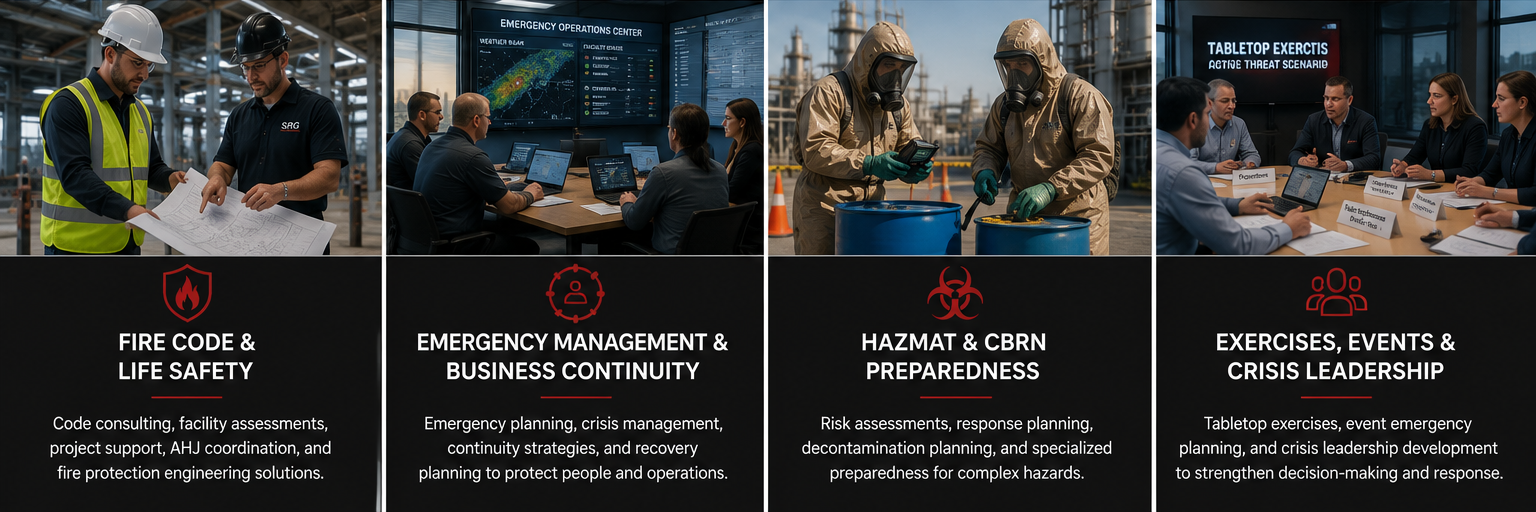
Summit Response Group provides specialized consulting services designed to help organizations reduce risk, navigate regulatory requirements, prepare for emergencies, maintain critical operations, and strengthen organizational resilience.
Our work centers on fire and life safety, emergency management, business continuity, hazardous materials and CBRN preparedness, emergency response planning, tabletop exercises, event preparedness, and crisis leadership.
We work with businesses, industrial facilities, government agencies, municipalities, healthcare organizations, developers, commercial facilities, campuses, and event operators to identify gaps and build practical solutions that can be implemented, tested, and maintained.
-
Navigate requirements. Reduce risk. Keep projects and operations moving.
Fire and life safety requirements can affect construction, facility operations, occupancy, insurance, emergency response, and overall organizational risk.
Summit Response Group helps clients understand applicable requirements, identify compliance concerns, document existing conditions, coordinate with stakeholders, and develop a clear path toward resolution.
Fire Code Consulting
Services may include:
Applicable fire code and standard research
Code interpretation and compliance support
Documentation of existing conditions
Review of fire and life safety concerns
Development of compliance strategies
Technical findings and written reports
Corrective-action planning
Support during code-related project disputes
Facility Fire & Life Safety Assessments
We evaluate facilities to identify fire and life safety concerns before they become larger operational, regulatory, or liability issues.
Assessments may include:
Means of egress
Exit access and exit discharge
Emergency lighting
Exit signage
Portable fire extinguishers
Fire department access
Fire protection system documentation
Fire prevention practices
Hazardous-material considerations
Emergency procedures
Life safety documentation
General fire-code readiness
Assessments are designed to provide clients with prioritized findings and practical corrective actions.
Pre-Inspection Readiness
Prepare before an AHJ, insurer, corporate auditor, or regulatory inspection.
Summit can review the facility, documentation, procedures, and known concerns to identify issues that should be addressed before the formal inspection occurs.
Construction & Development Support
Fire and life safety issues can delay projects when requirements, design intent, field conditions, and AHJ expectations do not align.
Summit can assist with:
New construction and renovation projects
Fire department access concerns
Fire-flow and water-supply coordination
Field-condition documentation
Code research
Stakeholder meetings
AHJ coordination
Plan-review support
Corrective-action development
Municipal Fire Marshal & Code Support
Smaller municipalities may need additional technical or administrative support without adding a full-time position.
Potential services include:
Fire-code consulting
Inspection-program support
Plan-review coordination
Developer communication
Documentation and reporting
Corrective-action tracking
Fire prevention program development
Specialized project review
Fire Protection Engineering Coordination
When a project requires professional engineering analysis, calculations, system design, performance-based solutions, or sealed technical documents, Summit Response Group coordinates those needs through qualified fire protection engineering partners.
Summit can remain involved as the client-facing consultant, helping connect operational concerns, code requirements, AHJ expectations, and engineering recommendations.
-
Build plans that work when normal operations stop.
Emergency plans must be more than documents stored in a binder or shared drive.
Summit Response Group develops practical emergency-management programs that establish responsibilities, decision-making processes, communications, protective actions, and coordination before an incident occurs.
Emergency Operations Planning
Services may include:
Emergency operations plans
Emergency action plans
Site-specific emergency procedures
Crisis-management plans
Emergency notification procedures
Evacuation planning
Shelter-in-place planning
Severe-weather procedures
Medical emergency procedures
Fire emergency procedures
Utility-loss procedures
Workplace violence planning
Cyber-disruption operational procedures
Emergency Management Program Development
For organizations building or improving an emergency-management capability, Summit can help establish:
Program governance
Roles and responsibilities
Emergency-management policies
Incident-management structures
Emergency coordinator responsibilities
Emergency operations center procedures
Internal and external communications
Mutual-aid coordination
Plan maintenance cycles
Exercise programs
Corrective-action processes
Emergency Operations Center Support
Summit can help organizations establish or improve an Emergency Operations Center or crisis-coordination structure.
Services may include:
EOC activation criteria
Position responsibilities
Situation reporting
Executive briefings
Incident tracking
Decision logs
Resource coordination
Operational checklists
Communications procedures
Recovery transition procedures
BUSINESS CONTINUITY
Protect critical operations before disruption becomes a crisis.
Emergency response protects people.
Business continuity protects the organization’s ability to continue delivering essential products, services, and functions.
Summit Response Group helps organizations identify critical operations, understand dependencies, evaluate vulnerabilities, and build practical continuity and recovery strategies.
Business Continuity Planning
Services may include:
Business continuity plans
Continuity of operations plans
Department-level continuity procedures
Critical-function identification
Alternate operating strategies
Staffing continuity
Facility-loss planning
Technology disruption planning
Supply-chain considerations
Vendor dependency planning
Recovery priorities
Reconstitution planning
Business Impact Analysis
A Business Impact Analysis helps determine which functions are truly critical and what happens when they become unavailable.
Summit can assist organizations in evaluating:
Critical business functions
Maximum tolerable downtime
Recovery priorities
Staffing dependencies
Technology dependencies
Facility dependencies
Vendors and suppliers
Communications requirements
Financial impacts
Operational impacts
Regulatory impacts
Continuity Readiness Assessments
For organizations with existing plans, Summit can evaluate whether the program is current, practical, and capable of supporting real-world disruption.
Findings can be organized into:
Immediate priorities
Short-term corrective actions
Long-term resilience improvements
-
Prepare for hazards that require specialized planning.
Hazardous materials and chemical, biological, radiological, and nuclear incidents can rapidly overwhelm organizations that have not planned beyond basic regulatory documentation.
Summit Response Group helps facilities and leadership teams understand their exposure, identify capability gaps, and develop practical response strategies.
Hazmat Risk & Readiness Assessments
Potential assessment areas include:
Hazardous-material inventories
Storage and handling practices
Emergency procedures
Internal response capabilities
External responder capabilities
Detection and monitoring considerations
Decontamination capability
PPE considerations
Evacuation and shelter strategies
Mutual-aid coordination
Emergency communications
Recovery considerations
CBRN Preparedness
CBRN consulting may include:
CBRN vulnerability assessments
High-consequence threat planning
Chemical threat preparedness
Biological incident preparedness
Radiological emergency planning
Suspicious-substance procedures
Protective-action planning
Executive-level CBRN briefings
Continuity considerations for CBRN incidents
Response capability evaluations
Decontamination & Protective-Action Planning
Summit can assist organizations with:
Decontamination concepts
Facility decontamination planning
Protective-action procedures
Shelter-in-place decisions
Evacuation decision-making
Personnel accountability
Contamination-control concepts
Coordination with public-safety agencies
Facility-to-Responder Coordination
One of the most important parts of Hazmat preparedness is understanding how facility personnel and outside responders will work together.
Summit can help define:
Initial facility actions
Emergency notification
Hazard information transfer
Site access
Command relationships
Facility representative responsibilities
Responder support requirements
Recovery and reentry procedures
-
Turn emergency responsibilities into actionable procedures.
Emergency response plans should clearly explain what needs to happen, who has authority, how decisions are made, and when to call in outside resources.
Summit develops customized response procedures based on the actual facility, organization, hazards, staffing, and external response capabilities.
Planning can address:
Fire
Medical emergency
Hazardous-material release
Severe weather
Power failure
Utility loss
Cyber disruption
Workplace violence
Active aggressor
Facility evacuation
Shelter in place
Mass notification
Fatality or serious injury
Supply-chain disruption
Transportation incidents
Security events
Other site-specific risks
TABLETOP EXERCISES
Test the plan before the emergency tests it for you.
Tabletop exercises give organizations an opportunity to evaluate plans, responsibilities, communication, coordination, and decision-making in a controlled environment.
Summit designs and facilitates exercises around the client’s actual risks and objectives.
Exercise Services
Programs may include:
Exercise objectives
Scenario development
Situation manuals
Facilitator guides
Participant materials
Scenario injects
Executive decision points
Facilitated discussion
Hotwash
After-action reporting
Improvement planning
Corrective-action tracking
Exercise Topics
Exercises may address:
Fire
Hazardous-material release
CBRN incident
Severe weather
Extended power outage
Cyberattack
Facility evacuation
Workplace violence
Supply-chain disruption
Loss of utilities
Fatality or serious workplace injury
Mass-casualty incident
Business interruption
Overseas or multi-site disruption
Exercises may be developed for operational personnel, executives, emergency teams, or a combination of participants.
EVENT EMERGENCY PLANNING
Plan for the event—and what happens when something goes wrong.
Large gatherings, outdoor events, corporate functions, sporting events, festivals, and public events create unique emergency-management challenges.
Summit focuses specifically on the safety, preparedness, and continuity components of events.
Services may include:
Event emergency action plans
Incident action plans
Emergency communications
Severe-weather planning
Evacuation planning
Shelter procedures
Medical response coordination
Fire and life safety considerations
Public-safety coordination
Command structure development
Emergency notification procedures
Contingency planning
After-action reviews
Weather Decision Support
Weather can quickly change the risk profile of an event or outdoor operation.
Through specialized partners, Summit can incorporate professional weather intelligence and monitoring into emergency-planning and decision-making processes.
Potential applications include:
Lightning
Severe thunderstorms
High winds
Extreme temperatures
Flooding
Winter weather
Operational trigger points
Event suspension or evacuation decisions
CRISIS LEADERSHIP
Strong plans still require people who can make decisions under pressure.
Crisis leadership is integrated into Summit’s emergency-management and continuity work because even the strongest technical plan can fail without clear leadership, communication, and decision-making.
Services may include:
Executive crisis-management workshops
Leadership under uncertainty
Crisis decision-making
Roles, responsibilities, and authorities
Crisis communications
Command-team alignment
Trusted autonomy
Leadership during operational disruption
Post-incident leadership
Facilitated executive exercises
Summit’s crisis-leadership work is designed for organizational leaders, managers, incident teams, and decision-makers, not as a general public-safety certification program.
-
ItemOne consulting relationship. Specialized expertise when needed.
Some projects require capabilities beyond Summit Response Group’s direct consulting scope.
We work with qualified partners who can provide specialized technical services while Summit helps coordinate the broader project and ensure the work supports the client’s operational objectives.
Partner capabilities may include:
Fire Protection Engineering
Engineering analysis
Fire protection system design
Hydraulic calculations
Performance-based solutions
Alternate means and methods
Technical plan review
Sealed engineering documents
Weather Intelligence & Monitoring
Professional forecasting
Real-time weather monitoring
Severe-weather alerting
Event decision support
Business-continuity weather intelligence
Specialized Planning & Technical Support
Additional specialists may be incorporated when needed based on project scope, location, hazards, regulatory requirements, or operational complexity.
Our Approach
Prepared. Ready. Resolved.
Prepared
Understand the risk.
We assess conditions, evaluate requirements, identify vulnerabilities, and establish clear priorities.
Ready
Build the capability.
We develop plans, coordinate stakeholders, establish procedures, and validate readiness through exercises and assessments.
Resolved
Close the gap.
We help clients implement corrective actions, document decisions, strengthen operations, and maintain long-term readiness.
Not Sure Where To Start?
Organizations do not always know exactly which service they need.
You may have:
A fire-code issue delaying a project
An emergency plan that has not been reviewed in years
A business continuity plan that has never been tested
A hazardous-material risk you are unsure how to manage
An upcoming event requiring emergency planning
A leadership team that needs to exercise its crisis-management responsibilities
A facility preparing for an inspection
A problem that crosses several areas at once
Summit Response Group can begin with the issue, identify the gaps, and help determine the next responsible step.